The ALS Global Research Initiative: Pioneering ALS Research Across the Globe
January 27, 2026
Looking back at 2025: A spotlight on Research We Conduct
ALS is a rare disease that affects people of every race and ethnicity around the world. However, clinical trials enroll primarily people of white, European descent resulting in a biased, incomplete view of disease biology across the ALS global population. The ALS Global Research Initiative (AGRI) is the only comprehensive, global research effort that brings together two complementary clinical studies designed to uncover the causes of ALS and identify new biomarkers that can diagnose the disease earlier, track its progression, and predict outcomes.
These studies provide researchers unprecedented access to patient data and biosamples worldwide, rapidly accelerating new discoveries and driving progress toward more effective therapies. Ultimately, inclusive research strengthens scientific validity, improves patient outcomes, and helps ensure that breakthroughs benefit everyone, not just a subset of the population.
In 2025, we launched the AGRI webpage, a central resource showcasing our groundbreaking efforts to diversify and expand ALS research globally.
The Global Natural History Study (GNHS):
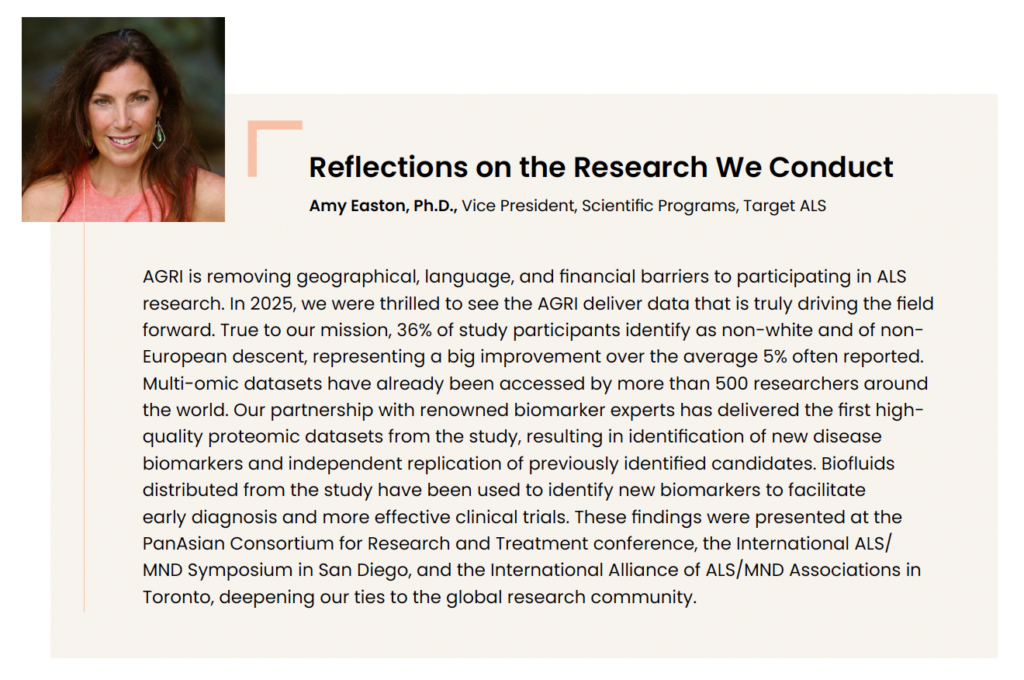
The Target ALS Global Natural History Study (GNHS) continues to grow as a cornerstone of global ALS research. Across 14 active sites worldwide, the study has now collected more than 30,000 blood, urine, and spinal fluid samples, with whole genome sequencing performed on every patient’s blood sample. In 2025, we introduced long-read sequencing, a powerful new technology that can detect genetic risks missed by older methods. All data generated is freely shared through the Target ALS Data Engine. To strengthen our global reach, new collection sites launched in Puerto Rico, Colombia, Israel, and South Korea, with Malaysia anticipated next. Importantly, samples representing non-Caucasian ancestry increased from 10% in 2023 to 36% in 2025, expanding the diversity of the repository. With broader global participation and cutting edge sequencing, the GNHS is building one of the most diverse and powerful ALS data resources in the world, bringing us closer to unlocking the underpinnings of the disease for all people.
Community-Based Pop Up Clinics
Many people living with ALS, especially those from underserved communities, face barriers that make it difficult to take part in research, including financial challenges, limited access to care, lack of information, and the burden of traveling to specialized clinics. To help bridge this gap, Target ALS launched a series of community-based pop-up clinics in partnership with local ALS centers and organizations.
Through these one-time blood collection events, the study aims to enroll about 5,000 individuals living with ALS and 1,000 healthy controls. Each participant provides a single blood sample and completes an environmental questionnaire, offering a simpler, more accessible way to contribute to research. By expanding who can participate, these clinics are helping ensure that future ALS treatments are safe and effective for everyone.
In 2025, we saw progress through two community-based pop-up clinics in Arizona. Earlier in the year, our second pop-up clinic in Phoenix took place on Rare Disease Day, February 28, drawing both people with ALS and healthy volunteers to contribute to the study. By the end of the day, 23 participants had joined, underscoring the appetite for accessible research opportunities within local communities.
In September, Target ALS hosted its third AGRI Pop-Up Clinic in partnership with ALS Arizona, bringing an opportunity to participate in research directly to the Tucson community. The event invited both people living with ALS and healthy controls to contribute blood and saliva samples, which are then analyzed.
All data become immediately available to scientists in our effort to accelerate discovery through globally diverse datasets and our bold use of long-read sequencing to identify novel genetic risk factors of ALS. What made the Tucson event stand out was the community’s engagement; participants not only donated samples but shared ideas and questions that will help shape future research. As CEO Manish Raisinghani noted, “The voices of people living with ALS, alongside their families and healthy volunteers, guide us in shaping research that is not only scientifically rigorous but also deeply human.”
By lowering barriers to participation, AGRI Pop-Up Clinics are helping build a faster, more inclusive research ecosystem: one that reflects the diversity of those impacted by ALS and ensures future treatments are safe and effective for everyone.
“Target ALS is proud to be leading the first ever in-community outreach events to accelerate our understanding of genetic and environmental risk factors for disease. If we want effective treatments for everyone with ALS, we need research that includes everyone. Community outreach events like this are making that possible — one blood sample at a time.” – Laura Dugom, MPH, Associate Director of Clinical Research, Target ALS
Related News


Shelley Metzenbaum: A Life of Purpose, Reframed by ALS
March 19, 2026
The One He Trusted Most: Erin’s Caregiving Story
March 17, 2026