
Target ALS Research Cores: Empowering Global ALS Discovery
January 23, 2026
Looking back at 2025: A spotlight on Research We Enable
Target ALS continues to break down barriers to progress by offering no-strings-attached access to critical tools and resources through our Research Cores. These shared resources address longstanding challenges in ALS research that have historically slowed discovery, including limited access, high costs, and lack of standardization.
The Research Cores accelerate drug discovery and biomarker development while fostering collaboration across the global ALS community. In 2025, Target ALS invested over $8 million to empower scientists with the materials, data, and infrastructure they need to drive progress from the bench to the clinic.
From our Postmortem Tissue Core to the Longitudinal Biofluids Core powered by our Global Natural History Study (GNHS) and open-access Data Engine, Target ALS provides researchers worldwide with state-of-the-art biosamples, datasets, antibodies, and more, with no reach-through on intellectual property (IP). These tools are available to both academia and industry, ensuring that scientific breakthroughs can move swiftly and collaboratively toward therapies for people living with ALS.
To date, more than 1,750 projects have relied on these resources, spanning basic biology, target validation, biomarker discovery, and therapeutic development.
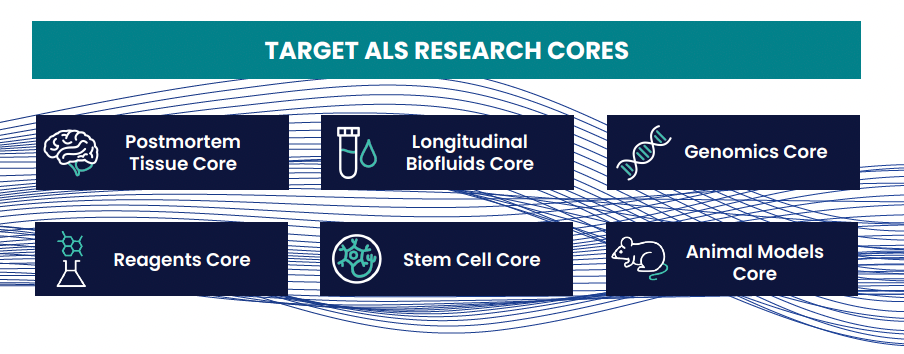
And the momentum is only growing: over 500 researchers have accessed our Data Engine, while global consortia of preeminent scientists are working together with Target ALS funds to share data, replicate findings, and amplify impact. At the 2025 Annual Meeting, dozens of scientists presented posters and abstracts showcasing research made possible through Target ALS’s Biofluids, Postmortem Tissue, and Data Engine core resources. These projects reflect our vision to democratize ideation and innovation in ALS worldwide, empowering every qualified researcher, regardless of location or affiliation, to access the same foundational tools needed to make discoveries.
Why It’s Different
The Target ALS Research Core model is unique. Unlike traditional grant-restricted or proprietary systems, our infrastructure is built on open science principles: shared access, standardized protocols, and unrestricted use.
By removing logistical and financial barriers, we’ve created a platform where ideas can move freely, where collaboration replaces competition, and every researcher can contribute to accelerating the development of effective ALS treatments.
Core Spotlights
Postmortem Tissue Core: The Gold Standard for ALS Research
The Target ALS Postmortem Tissue Core has been a cornerstone resource since 2014, providing brain and spinal cord tissues that are uniquely valuable for studying ALS at the cellular and molecular level. These samples allow scientists to track disease progression, understand genetic influences, and identify therapeutic targets; insights that cannot be gained from other models.
Built through contributions from six leading ALS research institutions and expert neuropathologists, the Core has grown to 534 cases, including 75 gene mutation cases, making it the largest ALS tissue repository in existence. Since its launch, the Core has steadily expanded its reach and capabilities. In 2025 alone, it fulfilled 50 tissue requests—nearly one per week—supporting researchers worldwide in their search for new answers.
One of the most exciting recent examples of how this resource accelerates progress is its role in the development of [18F]ACI-19626, a first-in-class PET tracer designed to visualize TDP-43, the protein that misbehaves in most ALS cases. Target ALS scientists provided guidance on the specific tissue required to validate this tool. For people living with ALS and their clinicians, this tracer could eventually make it easier to identify TDP-43-driven disease in living patients and match them to future therapies aimed at preventing this protein from clumping, mislocalizing, or malfunctioning.
Unlocking Hidden Signals: The Next Frontier in ALS Biomarkers
With support from Target ALS and powered directly by tools and materials from the Target ALS Reagents Core, Leonard Petrucelli (Mayo Clinic Jacksonville) and Nicholas Ashton (Banner Health Foundation) are advancing research on cryptic peptides; abnormal proteins that appear when TDP-43 malfunctions, a defining feature of ALS.
Using these high-quality reagents, the team can sensitively detect and measure cryptic peptides, accelerating efforts to evaluate them as early, non-invasive biomarkers. These biomarkers could help diagnose ALS sooner, track disease progression in real time, and monitor whether treatments are working. By pursuing cryptic peptides as a new class of biomarkers, this research has the potential to change how ALS is detected and managed, opening the door to earlier intervention and more personalized care.
Powering Progress: The Target ALS Data Engine
The Target ALS Data Engine, now used by more than 500 researchers worldwide, continues to expand as the leading open-access hub for ALS research, delivering transformative datasets that accelerate discovery. In 2025, three landmark initiatives pushed its impact even further.
1. Proteomics Data Now Available
The first batch of proteomics data from the Global Natural History Study (GNHS) is now complete and available through the Data Engine. Generated by Johan Gobom and Henrik Zetterberg’s team at the University of Gothenburg using the advanced TMTpro 35-plex method, this dataset includes approximately 2,000 proteins and 12,000 peptides from spinal fluid and plasma of people with ALS and healthy controls. Linked with longitudinal cognitive, motor, and clinical data, this resource will accelerate biomarker discovery, validate emerging findings, and spark new research directions through global collaboration.
2. Launching the Largest Single-Cell Dataset for ALS
In partnership with Panos Roussos and his team at the Icahn School of Medicine at Mount Sinai, Target ALS is preparing to release the largest single-cell dataset ever generated for ALS research. This pioneering resource, RNA sequencing from tens of thousands of individual cells across brain and spinal cord regions in ALS, FTD, and control cases, will allow scientists to explore disease mechanisms at unprecedented resolution. Public release is planned for the first half of 2026.
3. Genomic Breakthroughs Begin Here
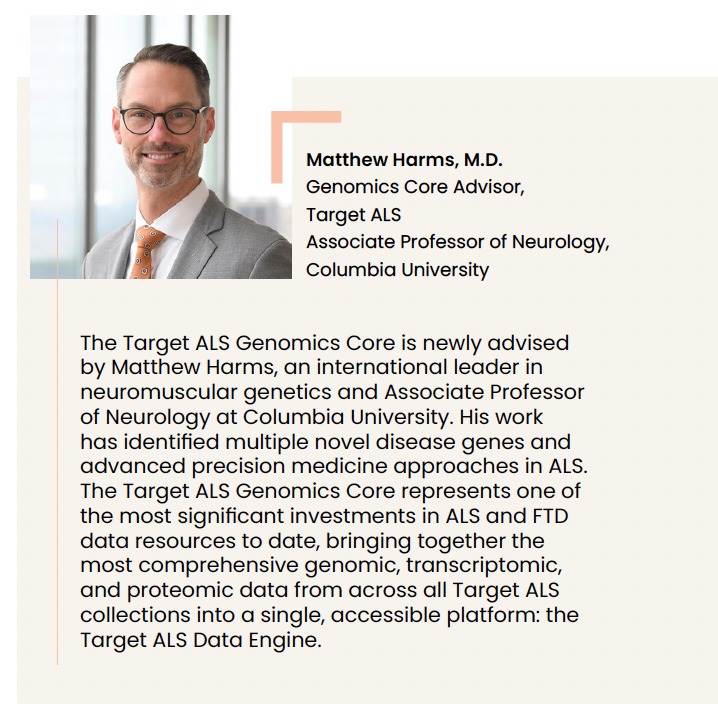
Target ALS has joined forces with PacBio to launch the largest ALS long-read whole-genome sequencing study to date. More than 6,000 genomes will be sequenced using PacBio HiFi technology, uncovering structural variants and hidden mutations that standard methods cannot detect. As part of the ALS Global Research Initiative (AGRI), all data will be openly shared via the Data Engine, removing barriers and enabling discovery worldwide.
Radical Data Collaborations with HiFi Solves
Target ALS is also a member of HiFi Solves, a global consortium designed to maximize the power of long-read sequencing. Unlike short-read methods, which provide fragmented views of the genome, long-read sequencing offers a complete, high-resolution picture, revealing repeat expansions and complex regions where ALS often hides.
By harmonizing HiFi data with DNAstack and connecting it to 15 other research groups across the U.S., researchers can now mine all datasets simultaneously. This allows rapid hypothesis testing, elimination of false signals, and identification of genetic patterns that would remain invisible in smaller, siloed datasets. What once took decades can now be achieved in just a few years.
Across Neurodegenerative Diseases
Target ALS is privileged to work alongside the Michael J. Fox Foundation, ASAP, 10,000 Brains, the AD Data Initiative, and the Ontario Brain Institute to tackle persistent barriers to effective data sharing across traditionally siloed research domains.
The 2025 Private Funders’ Parkinson’s Disease and Related Disorders (PDRD) Data Interoperability Summit brought together technical leaders from North American private funders and research organizations engaged in large-scale neurodegenerative data efforts. Together, they addressed these challenges through the lens of FAIR principles (Findability, Accessibility, Interoperability, and Reusability).
Continued collaboration in this area promises to accelerate discovery and innovation, with the potential to drive significant breakthroughs in the understanding, diagnosis, and treatment of neurodegenerative diseases.
In 2025, the Target ALS Data Engine provided researchers with the tools to uncover and act on new insights faster than ever before. By removing logistical and financial barriers, we have created a platform where ideas move freely, collaboration replaces competition, and every researcher can contribute to accelerating the development of effective ALS treatments.
Related News

A New Generation of ALS Researchers
March 9, 2026

Honoring the Women Who Carry the ALS Journey
March 5, 2026

Jacqueline Stepp's Story
March 5, 2026

A New Clue to One of the Most Common Genetic Causes of ALS and FTD
February 28, 2026